Write a transport brief, not just an address
Give the carrier a released manifest, case dimensions, verified weights and the required delivery window. Identify unusual items, lifting needs and any restrictions on stacking or orientation. Confirm whether the collection and delivery sites have suitable loading docks, forklifts or tail-lift access. Do not assume that a vehicle booking includes labour, unloading equipment or movement to the final room.
Include a named dispatch contact and a venue receiving role, along with a clear process for delayed arrival. At ExCeL London, Stockholmsmässan or Fira Barcelona, the public visitor entrance may be unrelated to event freight access. Use the organiser’s current logistics instructions and the venue’s approved route. A previous event’s access pass is not evidence of permission for the next one.
Pack for the equipment and its environment
Use protective packaging suitable for the asset, with support that prevents movement without placing pressure on vulnerable surfaces. Displays need protection against point loads; computers need secure internal and external transport arrangements consistent with their manufacturer’s instructions. Check case wheels, handles, catches and foam condition before packing. A damaged case can turn a familiar handling method into an unsafe one.
Keep accessories in identified compartments rather than loose beside delicate equipment. Coil cables using a method appropriate to their construction, protect connectors and avoid tight bends. Separate wet, dirty or damaged materials from ready-to-use stock. Where equipment has been exposed to cold conditions, follow manufacturer guidance on acclimatisation and condensation before powering it on.
Separate packaging from load restraint
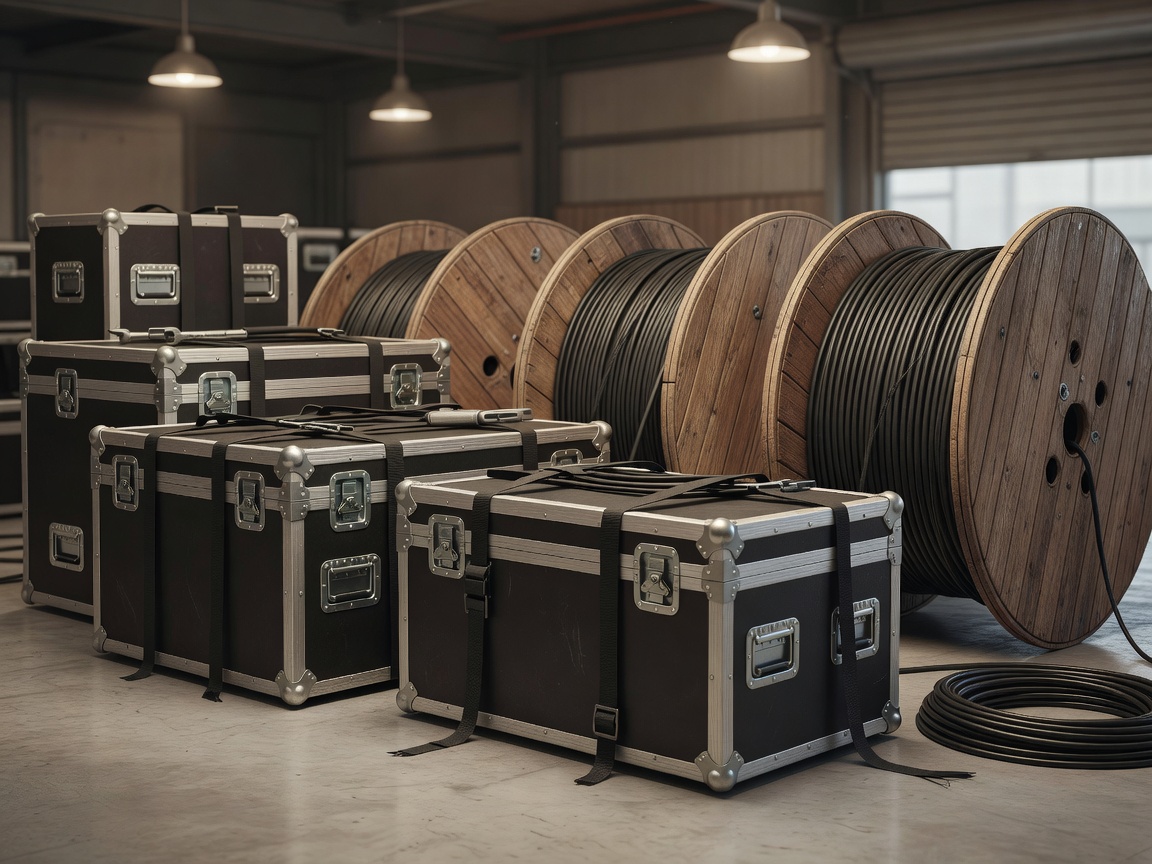
A flight case protects its contents but does not automatically remain safe inside a moving vehicle. The carrier must select a suitable vehicle and an appropriate load-securing method for the actual load. Share weight and handling information early enough for that assessment. Do not give improvised lashing instructions to untrained crew or assume a case handle is a rated restraint point.
The EN 12195 series is relevant to road-vehicle load restraint; the applicable requirements and methods depend on the equipment and operation. Treat standards as inputs to a competent transport plan, not a substitute for one. Where manual handling, tail lifts or mechanical lifting are involved, use trained people and follow site rules and equipment limits.
Plan unloading order around dependencies
Agree which equipment must be available first at the venue. Infrastructure cases may need to reach technical control before player stations can be connected, while floor protection may be required before any case moves into a finished space. Translate that sequence into a practical load plan with the carrier. The last item loaded is not always the first item needed.
Consider split loads and critical-path risk explicitly. Placing every essential component in a single shipment simplifies tracking but concentrates disruption risk. Splitting interdependent equipment across vehicles can create a different problem if only one arrives. Document the decision, identify what work can proceed after a partial arrival and avoid promising that a spare vehicle or local replacement will always be available.
The unloading sequence should serve the build, not merely empty the truck.
Check borders, batteries and insurance early
International transport requires a route-specific review. Movement within the European Union differs from movement across an external customs border, and ownership alone does not settle the paperwork. Ask the carrier or customs adviser whether temporary admission, an ATA Carnet or other documentation is appropriate. Keep serial lists aligned with any customs record and allow time for checks.
Identify batteries before dispatch. Lithium batteries can trigger requirements under ADR for road transport or the IATA Dangerous Goods Regulations for air transport, depending on classification and circumstances. Obtain competent advice rather than treating all battery-powered accessories alike. Separately confirm insurance scope, exclusions, declared values and claim procedures; carrier liability and equipment insurance are not necessarily equivalent.
Receive against a record
At dispatch, photograph visible case condition where useful, reconcile the count and record exceptions before departure. At arrival, confirm vehicle and load identity, inspect for visible damage and separate the external receiving check from later internal inspection. Note discrepancies on the relevant handover record promptly and preserve packaging when a damage investigation may be needed.
If a case is missing or damaged, assign an owner to the exception and tell the technical lead what dependency is affected. Do not silently substitute equipment that changes competition conditions. A good transport handover leaves the receiving team with a known load, a clear condition record and enough information to begin the planned setup safely.